 how-to
Cosmetic vs Structural Wall Cracks: How to Tell
Table of Contents
- Cosmetic vs Structural Wall Cracks: What the Difference Means for Your Home
- Signs of Foundation Problems That Go Beyond a Single Wall Crack
- How to Inspect Wall Cracks: A Repeatable Checklist for Homeowners
- Horizontal Cracks in Foundation Walls: What They Usually Mean
- Stair-Step Cracks in Brick: A Pattern Worth Taking Seriously
- How to Monitor Wall Cracks Over Time Without Guessing
- When Wall Cracks Need a Professional Assessment
- Frequently Asked Questions
Last Updated: October 5, 2026
Cosmetic vs Structural Wall Cracks: What the Difference Means for Your Home
Cosmetic vs structural wall cracks comes down to one question: is the house still holding itself up the way it should?
Here is the good news: most cracks in Pearland and Southeast Houston homes are cosmetic.
But some cracks signal something bigger. The table below sorts one from the other fast.
| What You See | Usually Cosmetic | Usually Structural |
|---|---|---|
| Width | Hairline, under 1/16 inch | Wider than 1/8 inch |
| Direction | Random, short | Vertical, horizontal, or stair-step |
| Doors and windows | Open and close fine | Stick, drag, or won't latch |
| Floors | Level | Sloping or bouncy |
| Over time | Stays the same | Gets wider or comes back after patching |
Below is a repeatable inspection you can do yourself, plus the signs that mean it is time to call someone.
Signs of Foundation Problems That Go Beyond a Single Wall Crack
One crack rarely tells the whole story. Foundation movement shows up in clusters, and the pattern matters more than any single mark.
Watch for these signs of foundation problems:
- Doors that stick in summer and free up in winter
- Windows that jam or leave a gap at the frame
- Floors that slope toward one side of the house
One of these alone is worth watching. Two or three together is a pattern.
Doors, Windows, and Floors: Movement You Can Feel
Sticking doors are often the first clue. A door that used to close with a push now needs a shoulder, which means the frame has shifted, and the frame sits on the foundation.
Try this test. Open a door halfway and let go. If it swings on its own, the floor beneath it is probably out of level.
Why Gulf Coast Clay Soil Drives Movement in Pearland Homes
The soil here is the root cause. Expansive clay soaks up water like a sponge and swells. When it dries, it shrinks and pulls away from the slab.
That cycle repeats every year. Homes in Pearland, Friendswood, and Alvin sit right in the middle of it. Slab-on-grade homes feel it most, but pier-and-beam homes move too when the soil under the piers shifts.
How to Inspect Wall Cracks: A Repeatable Checklist for Homeowners
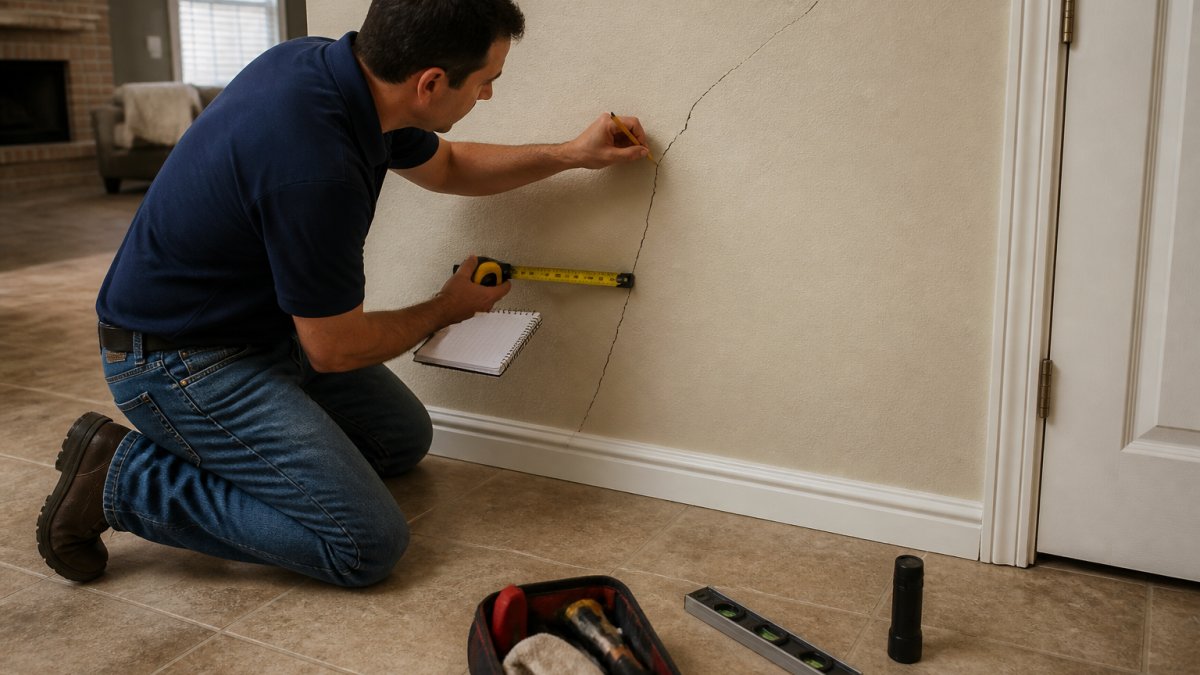
A good inspection takes about 20 minutes and a few basic tools. You do not need to be an engineer to tell a cosmetic crack from a structural one.
Grab a tape measure, a pencil, a notebook, and your phone camera. Then work through this list:
- Walk every room and note each crack's location
- Measure the width at the widest point
- Note the direction: vertical, horizontal, or diagonal
Horizontal Cracks in Foundation Walls: What They Usually Mean
Horizontal cracks in foundation walls deserve more attention than vertical ones. A horizontal crack runs sideways across the wall and usually points to soil pressure pushing inward, not the wall pulling apart on its own.
That pressure builds when water pools against the foundation. Gutters that dump next to the house, downspouts that stop short, and grading that slopes toward the slab all feed the problem, and in Pearland, Friendswood, and Alvin, where afternoon storms can drop an inch of rain in an hour, it builds fast.
Why Horizontal Cracks Are Different From Vertical Ones
A vertical crack in a foundation wall often follows a control joint or a cold pour line, a seam where concrete was placed in two stages. Those are common and frequently harmless.
In plain English: a vertical crack is often the wall saying "I was built in pieces." A horizontal crack is often the wall saying "something is pushing me."
Reading the Severity of a Horizontal Crack
Not every horizontal crack is urgent. Use these signals to sort them:
- Hairline and stable: A thin horizontal line, under 1/16 inch, that has not changed in a year is usually a shrinkage or curing crack. Note it and monitor it.
- Wider in the middle than at the ends: This bowing pattern means the wall is being pushed outward at its center. That is a real warning sign.
- A wall that bows or bulges inward: Stand back and sight along the wall. If it curves, the crack is a symptom, not the problem.
A horizontal crack plus a bowing wall needs a professional look, not a tube of sealant. Patching the crack without addressing the soil pressure behind it is like bandaging a hose that is still running.
What to Do Before You Call
You can gather useful information in a few minutes:
- Photograph the crack with a ruler in frame, and note the date.
- Check the outside of the wall for the same crack pattern.
- Look at the grading and gutters near that wall. Does water drain away or toward the house?
- Test the doors and windows nearest that wall for sticking or binding.
That record helps whoever inspects the home see whether the movement is active or has settled, and gives you a baseline to compare against in 30 days.
How This Fits the Local Picture
In slab-on-grade homes, the foundation wall is often the perimeter beam, and horizontal cracking there usually traces back to soil movement at the edge of the slab. In pier-and-beam homes, the wall may be brick veneer over wood framing, and a horizontal crack can indicate the veneer is separating from the frame. Both patterns are worth documenting and both are reasons to request an inspection through Foundation First TX.
Stair-Step Cracks in Brick: A Pattern Worth Taking Seriously
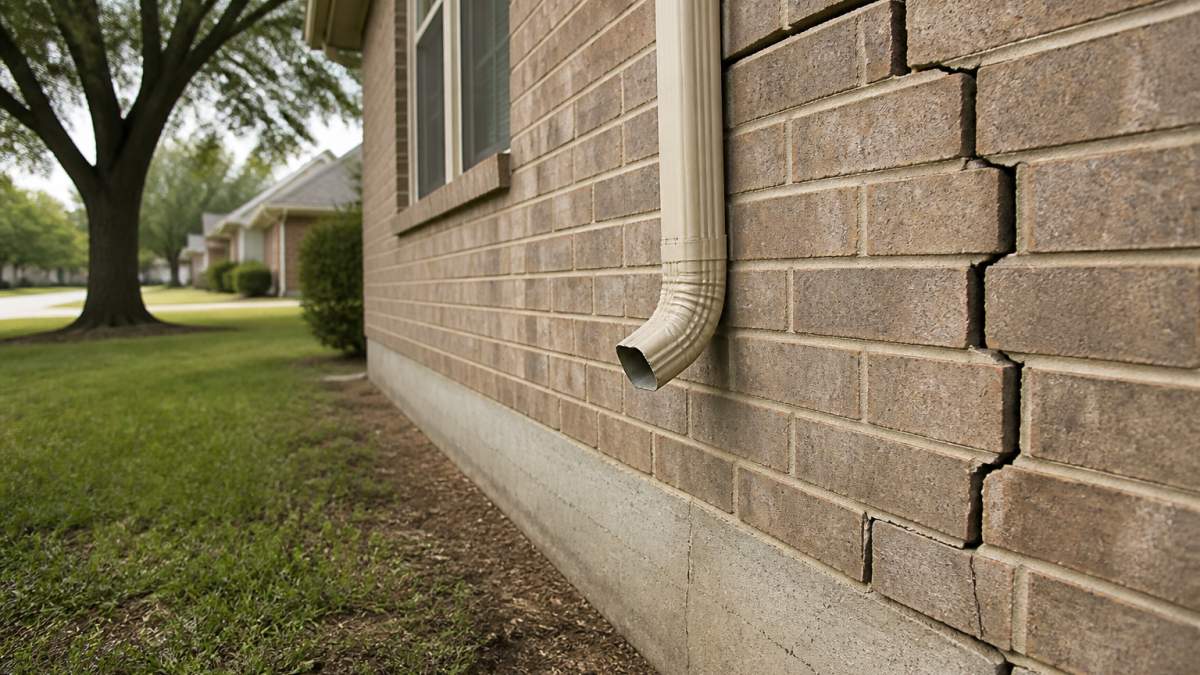
Stair-step cracks in brick follow the mortar joints in a rising pattern, like a set of stairs. This almost always means the foundation has settled unevenly: one side of the house dropped more than the other, and the brick veneer cracked along its weakest path, the mortar.
Vertical cracks in brick are often less urgent. Stair-step cracks wider than a pencil line, or near a corner, are the ones to flag.
How to Monitor Wall Cracks Over Time Without Guessing
Monitoring turns a guess into a record. You cannot tell if a crack is stable from a single look. You can tell in 60 days with two measurements.
Here is how to monitor wall cracks the simple way:
- Date each crack with a pencil mark at its tip
- Measure the width with a tape measure and write it down
- Take a photo with a ruler in frame
- Repeat every 30 days for three months
- Compare notes: same width means stable
A crack that stays the same width through a wet spring and a dry summer is likely cosmetic. A crack that grows after a drought or a heavy rain is tracking soil movement.
When Wall Cracks Need a Professional Assessment
Most wall cracks are cosmetic and can be monitored at home. But some patterns mean it is time to stop watching and get an expert opinion. The trick is knowing which is which.
Urgent Signs: When to Act Now, Not Later
A few crack situations warrant prompt attention rather than a routine appointment, because movement may be active and fast:
- A crack that has widened noticeably in a short time, days or weeks, not seasons.
- A wall that is visibly bowing, bulging, or leaning. Sight along it from the end; if it curves, that is a structural signal.
- Doors or windows that suddenly bind, stick, or will not latch when they worked fine before. A sudden change means the frame has shifted.
If you see one of these, do not wait for the next seasonal check. Request an inspection.
Routine Signs: Worth a Scheduled Look
Other patterns are not emergencies but are worth a professional assessment on a normal timeline:
- A crack between 1/8 inch and 1/4 inch that has been stable for months.
- Multiple hairline cracks appearing in the same room or along the same wall.
- Cracks that recur after being patched.
What an On-Site Assessment Actually Looks At
A good foundation inspection is not just a glance at the crack. It evaluates the whole house as a system:
- Crack mapping: Location, direction, width, and whether the crack appears on both sides of the wall.
- Elevation checks: Measuring floor levels across the slab to see if one area has dropped relative to another.
- Drainage and grading: Where water goes when it rains, and whether gutters and downspouts are moving it away from the foundation.
How to Prepare for the Inspection
You can make the visit more useful with a little homework:
- Gather your photos and notes from monitoring. Even a few dated pictures help.
- Write down when you first noticed each crack and whether it has changed.
- Note any recent plumbing work, roof leaks, or drainage changes.
- List the doors and windows that stick or drag.
- Have your address and the approximate age of the home ready.
That helps the inspector separate old, stable movement from something active right now.
What Happens After the Assessment
If the inspection finds cosmetic cracks, you will likely get guidance to monitor and address drainage. If it finds signs of foundation movement, the next step is a conversation about repair options. At Foundation First TX, we do not perform repairs.
We schedule on-site evaluations for homeowners across Pearland, Friendswood, Alvin, Manvel, Sugar Land, Missouri City, League City, Pasadena, Iowa Colony, and Rosharon.
For general guidance on structural cracks and when they matter, the American Society of Civil Engineers publishes homeowner resources on home performance. The U.S. Geological Survey also explains how expansive clay soils behave, which is the main driver of movement in this region.
Frequently Asked Questions
How can I tell whether a wall crack is cosmetic or structural?
Start with width and behavior. A cosmetic crack is usually a hairline crack narrower than a credit card, often caused by concrete shrinkage or paint and drywall settling, and it stays the same size over months. A structural crack tends to be wider, longer, or paired with other warning signs like sticking doors, sloping floors, or gaps around windows. If a wall crack is widening, recurring after patching, or running in a stair-step pattern through brick, treat it as a sign of foundation movement and request a professional assessment.
When should I be concerned about horizontal cracks in foundation walls?
Horizontal cracks in foundation walls deserve attention because they often point to lateral pressure rather than simple settling. Soil pushing against a wall, waterlogged clay after heavy rain, or a bowing or bulging wall can all produce horizontal cracking. If the wall is also leaning or displacing inward, that is a structural warning sign. Take photos, note the date, and have a professional assessment before the crack grows or the wall shifts further.
What should I document before requesting a foundation inspection?
Photograph each crack with something for scale, like a coin or tape measure, and note the date. Measure the width and length, record the direction (vertical, horizontal, or diagonal), and mark whether it is on drywall, brick, stucco, or concrete. Also write down any related signs of foundation problems, such as sticking doors, uneven floors, or gaps at trim. This record helps an inspector see crack progression and decide what to examine on site.
Do widening or recurring wall cracks mean I need foundation repair?
Not automatically, but they are the clearest signal that movement is ongoing. A crack that returns after sealing or that grows over a few months means the cause was never addressed. In Southeast Houston, that cause is often expansive clay soil shifting with drought and heavy rain cycles, or a drainage issue channeling water toward the slab. An on-site inspection can confirm whether the movement is active and what repair scope, if any, makes sense for your home.
Cracks in your walls are common here, and most are harmless. The hard part is knowing which ones are not. If a crack is widening, or your doors and floors feel different than they used to, do not wait for it to get worse. Request an inspection through Foundation First TX. We will schedule a professional on-site assessment of your elevations, drainage, and soil conditions, then help you plan the next step with clear information instead of guesswork.